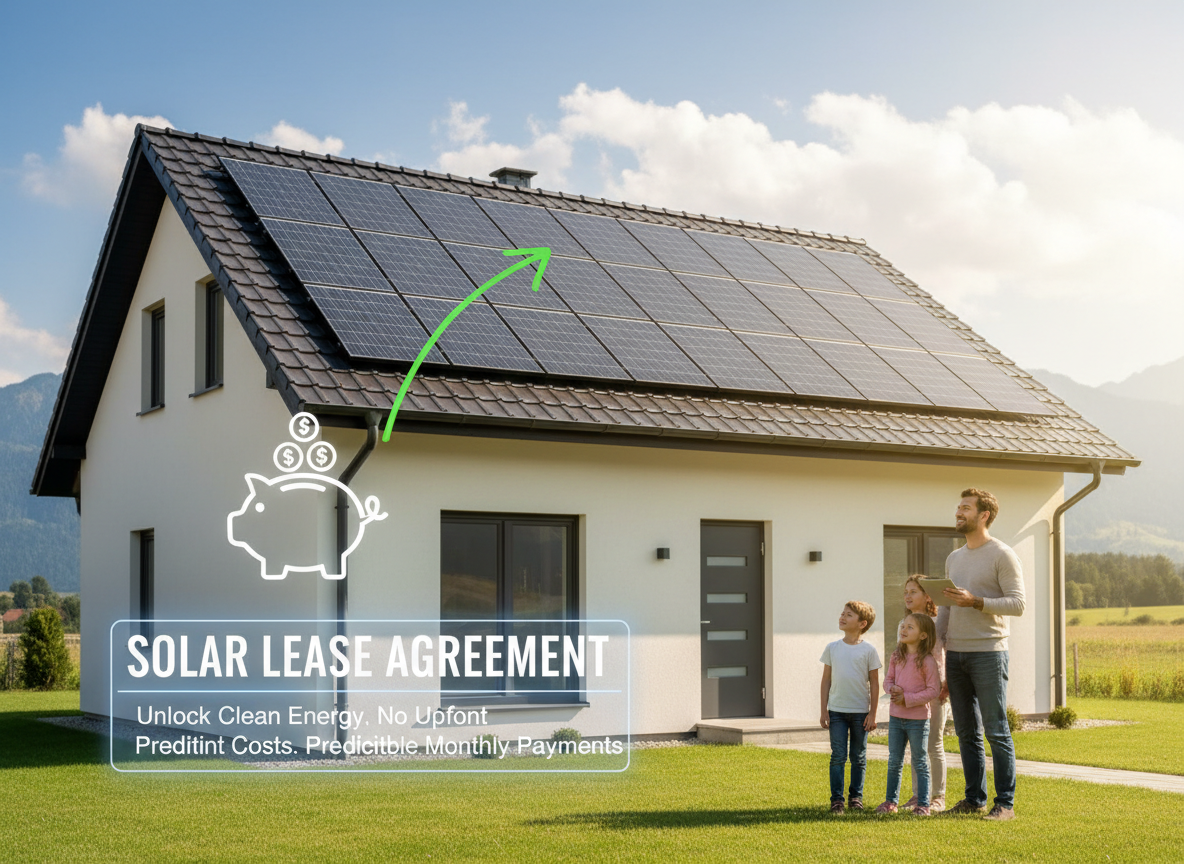
Despite high interest rates making borrowing money more difficult, people are still having solar panels installed at home thanks to the increasing popularity of solar leases.
A solar lease enables homeowners to reduce the upfront investment costs and liabilities of system ownership while still providing a reduced carbon footprint and lower electric bills every month for 20 years or more.
Before you sign one, however, it is critical to understand your agreement, as solar lease terms vary from company to company and contract to contract.
In this guide, we introduce everything you need to know about solar leases, including how they work, their pros and cons, and how to decide if leasing solar panels makes sense for you.
Understanding Solar Leases
The US Department of Energy’s Better Building Initiative defines a solar lease as “a type of lease specific to solar energy systems where the lessor owns the solar equipment and the customer rents it at a fixed monthly rate.”
In other words, after you sign, the solar leasing company will still own the panels installed on your roof while you pay a fixed monthly payment, not unlike the lease of a personal vehicle.
Most solar leases last for 15, 20, or 25 years and can sometimes be extended even further. While the panels generate power on your roof, your utility electricity costs drop. This enables most solar leases to deliver immediate savings with a monthly price lower than your electric bill.
Five basic principles of a solar lease agreement
- Homeowners leasing solar panels usually pay nothing upfront but make predictable monthly payments for the duration of the agreement.
- All of the power the solar panels generate is used in your home or goes to the utility grid, where it can generate bill credits through net metering or net billing, depending on where you live.
- Most solar leases include an annual escalator that raises monthly payments each year but is designed to increase slower than utility energy rates. If utility rates rise faster than your lease payments, you will save more money over the life of your agreement.
- For the lifetime of the agreement, the solar installer owns, maintains, and monitors the solar panel system.
- At the end of your agreement, the leasing company will remove your system or may present options to extend, buy out, or renew your lease.
Solar lease vs. solar loan
Outside of purchasing solar panels with cash, loans and leases are the primary ways homeowners go solar. Using a loan, you can finance your solar panel installation, own the system, and qualify for the federal solar tax credit.
Historically, most homeowners found greater long-term savings with solar ownership compared to a solar lease, though high interest rates are changing this for some. If you use a loan, you’ll likely save less than with a cash purchase, but both qualify you for the 30% federal tax credit.
With all of this in mind, there are instances in which high financing rates, low tax liabilities, or plans for the future can impact the choice between a solar loan and a lease agreement. (More on this later.)
Solar lease vs. power purchase agreement
Similar to solar leases, power purchase agreements (PPAs) are another third-party ownership model that gives homeowners an alternative to buying solar panels. As the name implies, a solar PPA is an agreement in which you purchase the actual solar power generated rather than the equipment used to make it happen.
Solar PPAs aren’t available everywhere in the US and take different forms. They may entail the ongoing purchase of solar electricity produced on your roof or off your property, the latter of which is referred to as a “virtual” power purchase agreement and is often used in community solar projects.
In either form of solar PPA, you pay for the amount of solar electricity your home consumes rather than a fixed monthly lease payment. Solar PPA rates are typically locked in at prices lower than average utility bill electricity costs.
Pros and Cons of Leasing a Solar Panel System
Although you should weigh the pros and cons of leasing solar panels for your own circumstances, the structure has several advantages and disadvantages overall. It is best to weigh multiple contract structures to determine what will provide the most savings and value for your home.

Solar lease pros
- Little or no upfront costs. A solar lease rarely includes any upfront costs to install the equipment.
- Fixed, predictable energy payments. Solar lease payments are locked in and predictable for the length of your contract, unlike utility energy rates.
- Immediate savings on energy bills. The power generated by your solar panels will reduce your energy bills.
- Worry-free operation. The solar energy company that installs your panels is responsible for ongoing monitoring and maintenance.
- No hidden costs. Any necessary panel, inverter, or part replacements are covered in your contract, as are your installation and eventual system removal.
Solar lease cons
- Missed opportunity to save more. While leasing is one way to save, owning your solar system will generally lead to greater long-term reductions in your home’s energy costs.
- Lease transfer must be included in a home sale. If you decide to sell your home during a solar lease, you will need to either transfer the contract to the new homeowner or terminate the agreement early.
- Will not increase home value. Whereas purchased panels are an asset, leased solar panels do not increase home value.
- Does not qualify for tax incentives or rebates. The majority of solar incentives can only be redeemed by system owners.
- Limited control over system performance. While a purchased system is yours to monitor or improve, a leased installation is only as good as the solar company that owns the panels.
Making the Decision: Is a Solar Lease Right for You?
A solar lease is a long-term commitment. Before you sign on the dotted line, it is critical to thoroughly review your lease terms and understand precisely how the electricity your solar panels produce will impact your savings.
Both solar leases and ownership models can yield long-term savings, though solar leasing may be a better choice in the two circumstances explored below.
No financing necessary
Solar leases and power purchase agreements are ideal for those who prefer not to take on debt to go solar. Interest rates reached a 22-year high in 2023, and a solar lease can help you avoid paying for them. Instead, you’ll have predictable monthly payments for 20 years or more designed to lower your ongoing energy expenses.
Tips to make leasing solar panels worth it
- Analyze your energy habits at home. This includes quantifying the electricity you use and pay for, finding ways to reduce consumption, and predicting how things may change in the future.
- Choose a lease with a solar production guarantee and an estimated energy output in writing. This will help ensure your solar panel system performs as advertised and delivers the value promised by your installer.
- Consider multiple lease agreements and compare those options with proposals for solar ownership. If your primary goal is to save money, this step is critical to determine the best way to install a new solar system on your home.
- Pay attention to any price escalators included in a proposed contract. This is important for both solar leases and PPAs.
- Read the fine print. Beyond the dollar amount of your lease payment, pay attention to things like early termination fees, buyout options, and renewal clauses.
Discover The Palmetto LightReach Energy Plan
The Palmetto LightReach Energy Plan helps homeowners across the US save money with solar panels while we take care of everything else. LightReach offers predictable payments designed to lower your overall electricity costs in year one.
LightReach customers get a 90% production guarantee and comprehensive solar system monitoring and protection for the 25-year life of their agreement, with no unexpected, out-of-pocket costs, ever.
LightReach also includes buyout options after five years, easy lease transfer processes in the event of a move, and comprehensive project management from installation day through decades of solar power production.
Conclusion
Solar leasing lets homeowners embrace green energy and save money in their fight against high energy bills. Signing a solar lease or power purchase agreement can enable over two decades of savings without any upfront costs or unexpected expenses later on.
Although those who purchase solar panels can take advantage of tax incentives and generally save more money in the long term, solar leasing lets you avoid high interest rates and works well for homeowners without a large federal income liability.